Knowing how to write dimensions correctly is essential. The usual order formost boxes and packages is length × width × height (L × W × H).
Carriers calculate cubic size, then dimensional weight, using that order. As such, getting it right can affect shipping costs and make it either cheaper or more expensive. In carrier language, as detailed byUSPS, length is the longest side, multiplied by width and height to get the cubic size.
Most carriers also ask you to round each measurement to the nearest whole inch and then divide the cubic inches by a dimensional weight divisor to get the billable weight.
For example,FedEx uses 139 for U.S., Puerto Rico, or international shipments and explains the rounding step explicitly. This article will go through and explain how to understand dimensions and answer related questions.
Clarity beats guesswork, especially when it comes to mathematics. In day-to-day work, how dimensions are listed can feel trivial. That is, until a misread number turns into a return, a reprint, or an extra charge. Online, how to read product dimensionsand how dimensions are writtenvary by category, but for cartons and most packages, the industry sticks to L × W × H.
On portals likeAmazon’s Seller Central, these three dimensions are illustrated as “longest side = length, median side = width, shortest side = height,” which answers the evergreen questions of: “In dimensions, what comes first?” and “Is it height x width or width x height?”
Importance of Accurate Dimension Notations
Dimensional-weight pricing means the billable weight is the greater of actual scale weight or dim weight, and this is computed from L × W × H. That’s why “what order do dimensions go in” and “how to write dimensions in the correct order” are practical questions to ask when packaging or shipping something. Take note that:
Rounding and the divisor can impact the billable weight.
Marketplace fees depend on dimensions, too.
Real-world calculators mirror the rules.
Common Use Cases for Writing Dimensions Correctly
You’ll use the same logic for dielines, shelving clearances, and PDP (principal display panel) specs.USPS defines length as the longest dimension and uses “length + girth” for certain limits, a reminder that how to write dimensions has rules that matter for compliance.
Packaging and shipping: Carriers price many parcels by dimensional weight. Since measurement corresponds to pricing, a wrong order or rounding error can move you into a higher fee tier.UPS, for example, publishes the same multiply-then-divide approach and actively promotes “cube optimization” (right-sizing boxes) to cut costs and fit more parcels per container.
Furniture and delivery: Retailers and consumer advocates emphasize measuring door width, entry depth, and diagonal clearances so big pieces actually make it into the room. After all, Consumer Reports highlights that misjudged dimensions are a major source of delivery problems and costly returns.
Blueprints and permits: Building departments require scaled drawings, with each part labeled with its dimensions. Wrongly labeled or incomplete dimensions can cause your permit to be delayed or rejected. City plan submittal checklists explicitly require dimensioned floor plans, ceiling heights, and site plans drawn to scale.
Online product listings and marketplace fees: OnAmazon, incorrect package dimensions can bump an item into a larger size tier and increase FBA fees. Seller Central defines product size tiers based on unit weight, actual size, and dimensional weight, and even tells sellers to compute for the total sizing using the longest side × median side × shortest side. So the order in which you list dimensions (and how you estimate them) directly affects fees.
Postal limits: The “length + girth” rule is used for maximum parcel size. Many services cap combined length and girth at 108 in (with different limits for specific products). If your measurement order is off, you can misclassify a package as mailable when it isn’t, or vice versa.
When you’re learning how to read dimensions, read them in order. The first number is length, the second is width, and the third is height. That’s the convention most people expect when they ask how to write dimensions.
If you need to show two measurements or sides only (a flat sheet or label), it makes sense to list length × width. When you type them, use a true multiplication symbol (×), not the letter x, for better readability.
What Are Dimensions and Why Are They Important?
Definition of Dimensions in Measurement
Lumen Learning highlights how dimensions describe an object in space using perpendicular axes: two dimensions for flat items (length and width), three dimensions for boxes (length, width, and height). People often ask: How do you measure dimensions? In every case, think “two on the base, one on the vertical.”
Difference Between Dimensions and Area or Volume
Area uses a two-dimensional expression (length × width). Volume uses three (length × width × height). For planning and quoting, even consumer publications remind you to measure length and width separately and compute the area as L × W before you budget.
Key Industries That Rely on Precise Dimensions
Packaging and logistics: Cartons, inserts, and shipping labels, where accurate L × W × H has a direct impact on fit and DIM-weight pricing
Construction or architecture: Room sizes, door or window openings, and clearances on plans where precise measurements enable permitting and installation
Retail and eCommerce: Product detail page specs and packaging sizes that prevent returns, misfits, and incorrect size-tier fees
Engineering and manufacturing: Drawings and tolerances for parts, assemblies, and fixtures, where the same notation keeps production in line
Standard Order of Dimensions
The General Rule
For cartons, the general rule answers the question “when listing dimensions, what comes first?”: L × W × H, with length as the longest base side.UPS’s dimensional page, for example, states it plainly—multiply the side that’s the longest by the other two to find the cubic size and avoid confusion.
For Different Objects
Boxes and Packages
Stick with L × W × H. This aligns with carrier calculators and the way boxes are designed and rated, settling the question of how to write dimensions for packaging.
Using the wrong order (for example, listing width before length) might not change the cubic volume mathematically, but it causes confusion in warehouse systems and packaging design software, where each side has a role. Packaging suppliers also use L × W × H when rating corrugated strength and designing inserts.
Floor Plans and Spaces
For floor plans and spaces, you’ll typically only see length × width (L × W). That’s because most layouts describe the footprint of a room or area, while the ceiling height is noted separately. For example, a real estate listing might read “Living room: 16 × 20 ft; ceiling height: 9 ft.”
Architects follow this same convention in blueprints so contractors know the horizontal span first, while the vertical dimension is treated as a different measurement.
The same applies to sheets of material (like plywood, drywall, or paper), where dimensions are written as length × width. Knowing this clears up any issue around “height × width or width × height” in prints and plans.
Screens and Monitors
Displays are marketed by their diagonal measurement. The width/height/depth follows in a spec table. You can refer to theVESA patterns (e.g., 100 × 100 mm) to learn how to write dimensions for mounting. It’s a W × H grid of mounting holes in millimeters.
Clothing and Textiles
Garment notation differs (waist × inseam, chest × length). List down your convention up front so the reader knows whether length or width comes first for this category.
When Depth Is Used Instead of Width or Length
Is Depth the Same as Length or Width?
People often search “Is length the same as depth?”, “Is depth the same as width?”, or “Are width and depth the same?”. Depth is the front-to-back distance from the viewing surface. In shipping, “length” is the side that’s the longest.
How Depth Is Used in Furniture and Shelving Measurements
Retail specs usually show width × depth × height (front-view logic), so buyers understand how much space a piece of furniture takes up when placed in a room. This is particularly useful when someone asks how to write dimensions for furniture.
How to Read and Write Dimensions
Reading Dimensions Correctly
When you see “12 × 8 × 6,” read it as length (12), width (8), and height (6). That’s the answer to “How are dimensions read?” and “Is the first measurement length or width?”. As mentioned, USPS reinforces that length is the longest dimension.
Understanding “X by X” Notation
Use the multiplication sign (×). Guidelines recommend using a centered dot or space between multiplied units to avoid ambiguity, which is why “12 × 8 × 6 in” reads cleanly.
Interpreting Product Listings
Sellers don’t always include orientation diagrams, so consistency is your friend. Amazon’sexample (“longest, median, shortest”) clarifies what comes first in measurements and how to write dimensions for PDPs. This comes in handy when you post product dimensions on Amazon or other platforms.
Writing Dimensions Properly
Choose one unit system per document (inches, centimeters, or meters), place a space between the value and unit (12 in; 30 cm), and keep precision reasonable. That approach also clarifies how to write dimension lines in PO forms and drawings.
Using Consistent Formatting
If a person from a different country will read the spec, note the primary unit (e.g., inches) and put the equivalent measurement in metric units in parentheses, or provide a separate sheet showing all dimensions in metric. Pick one and be consistent.
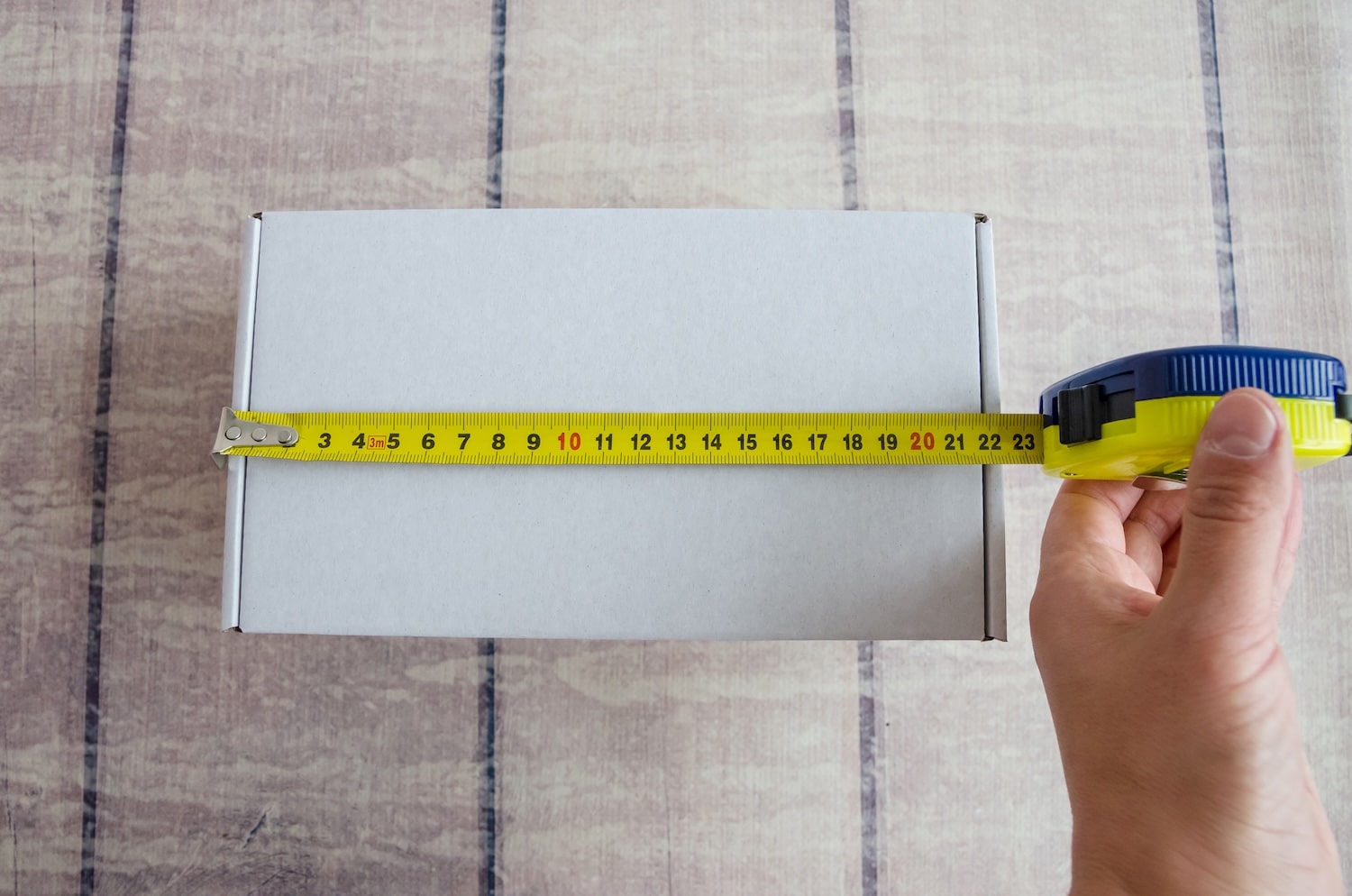
Place the object on a flat surface with the intended “base” facing you to ensure each dimension is measured accurately.
Measure length along the longest base edge.
Measure width along the shorter base edge (perpendicular to length).
Size up the height from base to top (vertical).
Jot down “L × W × H” with units.
For shipping, round up as the carrier requires.
How to Measure Length, Width, and Height
Think in perpendicular axes. In most cases, when we talk about length, it’s the longest base side. Meanwhile, width is the other base side, and height is vertical.
How to Measure Irregularly Shaped Objects
Use a bounding box large enough to contain the shape (tip-to-tip in each direction). If the object compresses or expands, add a tolerance so your measurements stay usable.
Common Mistakes and How to Avoid Them
Using two dimensions for a 3D box. Always add the third dimension. Many people copy the way flat items like paper are listed and forget height, but leaving it out creates costly errors. A box labeled “12 × 8” could mean a flat sheet, a 12 × 8 × 2 shipper (192 in³), or a 12 × 8 × 10 shipper (960 in³). Carriers and packaging teams can’t guess, so always provide the full length × width × height.
Mixing units. Pick inches or centimeters and stick with it. A spec like “12 in × 20 cm × 6 in” forces someone to convert on the fly, which often leads to rounding errors and incorrect quotes. To avoid mistakes, decide on a single system (inches or centimeters) for all dimensions in a document.
Typing “x” instead of the multiplication sign (×). Keyboard habit makes it easy to type the letter “x,” but “12x8x6in” is harder to read and can even be misinterpreted in technical drawings or software parsers. The proper symbol (×) adds clarity: “12 × 8 × 6 in.”
Forgetting carrier formulas like length + 2×width + 2×height (girth). Many shippers remember L × W × H for the inner content but forget the size limit rules carriers use. Always run both volume and girth calculations, and remember to round each side up to the nearest inch before submitting to a carrier.
Differences Between Length, Width, Height, and Depth
Clarifying Misconceptions
Length = longest base side. In most cases, length is defined as the longest horizontal edge on the base of the object. Even if a carton will stand upright later, you should still use the longest side of its base as the length when writing dimensions.
Width = the other base side. Width is the shorter horizontal edge on the same base as the length, always perpendicular to it. In shelving or cabinet measurements, width often refers to the left-to-right span across the front-facing side.
Height = vertical. Height runs straight up from the base to the topmost point of the object. For flat items like posters or paper sheets, height still applies, but since they’re 2D, you’ll typically only list the length and width.
Depth = front-to-back from the user’s viewpoint. Depth describes how far an object extends away from the viewer. For furniture, the order is often written as W × D × H, while for shipping cartons it’s usually L × W × H.
When to Use Each Term in Different Contexts
Use L × W × H for boxes, W × D × H for furniture, and diagonal for screens (plus VESA), which is why TV size tags read as diagonals rather than width × height.
Is Width and Depth the Same?
No. They have different labels for perpendicular axes in your chosen orientation. If a team keeps asking,“Is it width × length or length × width?”, put your convention in the first sentence of your spec and stick to it.
A leader in custom boxes and packaging materials, Refine Packaging is the top choice for 1000s of small businesses, Inc 5000, and Fortune 500 companies alike. With super fast production times, affordable pricing, and a sky’s the limit attitude, we’ll help you turn your custom packaging into a competitive differentiator. Contact us and a dedicated packaging specialist will guide you through every step of the custom packaging process without breaking a sweat.
Amanda is a professional writer and brand strategist at Refine Packaging who is based in Los Angeles, California. With a background in writing and journalism, Amanda entered the manufacturing industry 6 years ago to explore her unique passion for beautifully conceptualized packaging. With years of packaging experience, Amanda has a deep understanding about how brand psychology and box design trends impact emotions and desired actions. When she’s not writing, Amanda can be found snuggling her two Beagles or outdoors sipping on sparkling white wine.









 Alex Jasin

 Amanda Jane Rivera

 Asif Muhammad
 Erica Campbell



.svg)
Share